The internal model principle and good regulators
Projects | | Links:
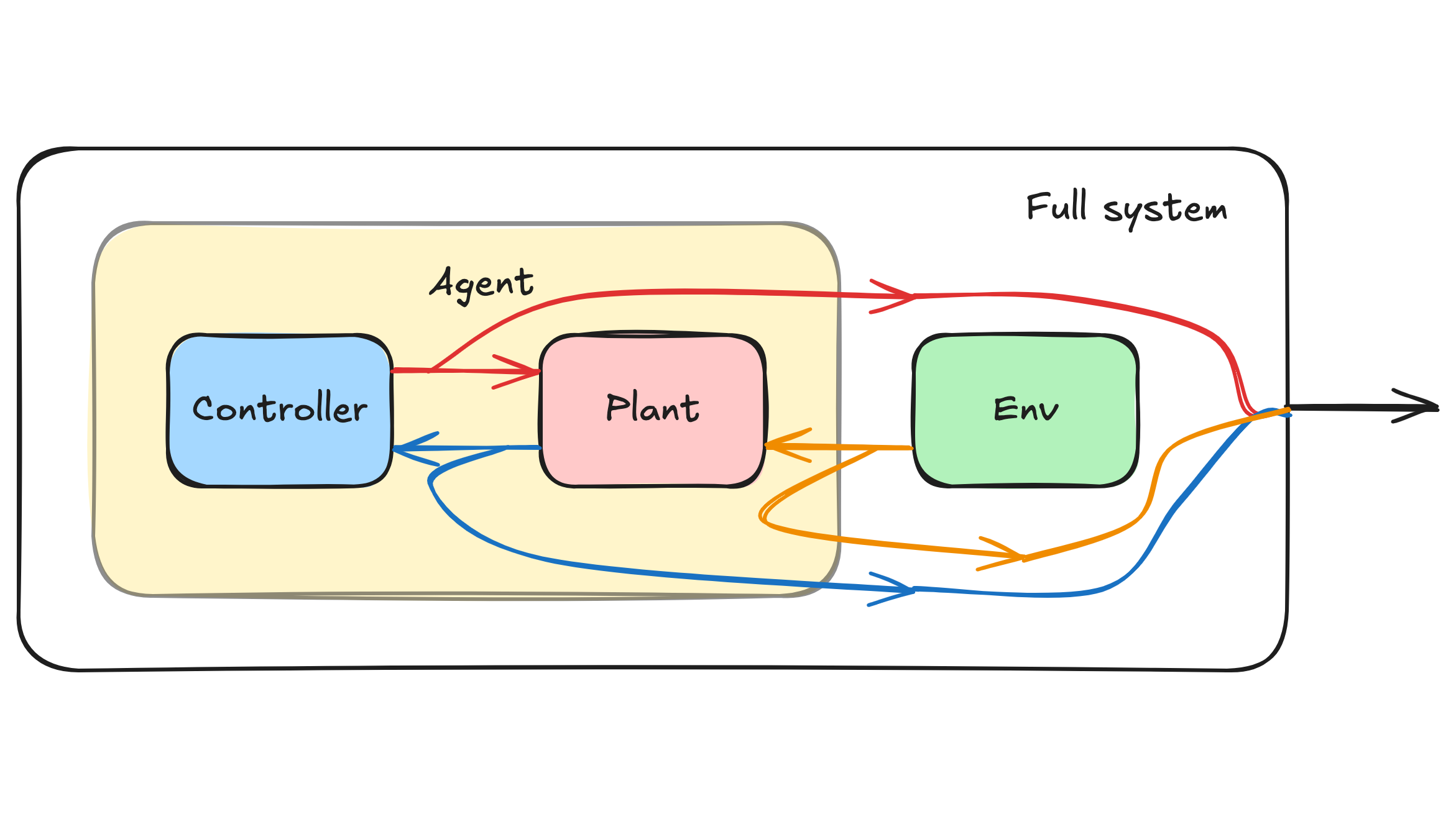
Conant and Ashby claimed that “every good regulator of a system must be a model of that system”, an idea taken up in control theory as the internal model principle. We ask when a system that regulates its environment can be said to model it, and how such models relate to the Bayesian models of cognitive science.
A Bayesian interpretation of the internal model principle gives a precise formulation of the principle using categorical systems theory, and shows that its notion of model is a special case of possibilistic Bayesian filtering. A longer summary is in this post.
A “good regulator theorem” for embodied agents shows that whenever an agent can perform a regulation task, an observer can interpret it as having beliefs about its environment, which it updates in response to sensory input.
The universal property of possibilistic belief updating shows that these beliefs, together with their possibilistic updating, generalise to a system in the sense of categorical systems theory with the universal property of a power object. In this precise sense, the agent’s ability to perform the task and the map from its states to beliefs are the same thing.
Papers
A Bayesian Interpretation of the Internal Model Principle
arXiv:2503.00511 · Preprint
A “good regulator theorem” for embodied agents
Artificial Life Conference (ALIFE) · Conference paper
The Universal Property of Possibilistic Belief Updating
Applied Category Theory Conference (ACT) · Talk proposal